The Bear’s Den in Taunton continues to be a great supporter of striped bass conservation. Their annual expo is coming up next Saturday the 21st 11am-6PM. Stripers Forever will have a booth there, so stop by, say hello and pick up a new hat. This show features some of the top names in fly fishing. Chris Owens of Geobass headlines the 2015 show! For full information check out the Bear’s Den website.
Featured
“Conservation” Equivalency or “Exploitation” Equivalency?
“Conservation” Equivalency or “Exploitation” Equivalency?
ASMFC Striped Bass Management Board Meeting on 2-5-15
By Ken Hastings, ASMFC Policy Coordinator of Maryland
Since the decision has been made by the Board to cut the coast-wide catch of striped bass (SB) by 25%, the member jurisdictions got a chance to propose the details of how they were each going to meet the new limits. In ASMFC terms, this is referred to “conservation equivalency.” In theory, it means that the states don’t have to follow the ASMFC guidelines for bag limits, sizes and seasons if they can come up with other ways to meet the same goals. Under this “give and take” arrangement between the governing Board and its members, less conservative approaches would not [knowingly] be approved.
The devil really is in the details as evidenced by the vast array of options presented by the members at the meeting on Feb. 5 in Alexandria, VA. Each member had multiple approaches to be considered and one had nine approaches to managing just the commercial quota. Altogether, there were over 50 recreational options and almost 20 commercial ones.
It is important to remember that the initial objective of the recent addendum was to reach a specific spawning stock biomass (SSB) goal by 2016. The 25% reduction predicted to reach the goal was based on data and assumptions threatened by massive uncertainties to the extent that the probability of reaching the 2016 goal was only 50% to start with. So, after years of debate and research, the probability of success for this “science-based” outcome was the same as the probability of getting a “heads” result from the toss of an unbiased coin before the Feb. 5 meeting. If conservation had been the true objective, one might expect that a higher percentage would have been selected to help swing the odds toward a successful outcome but it wasn’t.
Most of the meeting was spent lamenting the complexity of the options and the associated new uncertainties that would pile on top of the uncertainties plaguing the 25% decision in the first place. It was agreed that simple approaches would be easier for the fishermen to understand and for the police to enforce. The advantages of regional approaches with consistent rules for adjacent jurisdictions were generally accepted. Ease of enforcement (according to the enforcement committee) is better for bag and size limits than for slot limits. Having consistent rules for adjacent tributaries in the same jurisdiction is better than having multiple different sets of rules depending on where the fish are caught.
In some cases, the Technical Committee (TC) wasn’t able to predict variables like fishermen behavior. In the case of recreational poaching, for example, there is some prior year MRIP data regarding how many people kept too many fish or fished outside the size limits. While it is universally recognized that human nature probably precludes perfect compliance with any rule or law, and in spite of the 2013 MRIP data validating this premise for fishing, the TC assumed universal perfect compliance in evaluating the proposals for conservation equivalence. Most sources of compliance uncertainty were eliminated – intentional poaching, unintentional infractions based on ignorance of the rules, and law enforcement miscues over jurisdictional limits and conflicts for examples. A standard 9% was used for dead discards but it isn’t clear that a one-fish limit won’t encourage high-grading from the ice chest in order to maximize the size of that one fish. In the end, the TC admitted that they couldn’t scale the uncertainties because their magnitudes were too uncertain.
Since all of the proposals had been submitted to the TC in advance and were judged to result in at least the same conservation levels as the initial TC guidance, it appeared that all that discussion about uncertainty was just for show and everyone was going to get their choice of options from the laundry list they submitted. However, MD wasn’t completely happy with that approach and needed to squeeze just a little more out of their trophy season conservation equivalency by proposing a bag limit of one fish either between 28” and 36” OR one fish over 40.” Note that this is almost the same as one fish over 28” except for the four inches left out of the slot limit. Given all the uncertainties leading up to the 25% decision doomed to a coin toss success future, compounded by the uncertainties associated with the myriad of proposals, it seems unlikely that anyone understands SB population dynamics well enough to debate the four-inch part of the slot limit. The friendly amendment to change MD’s proposal seemed to be favorably received so the Potomac River Fisheries Commission threw their name into the pot as well.
It was like an hour plus of discussions about uncertainty and how to minimize it never happened. The motion, prepared before the meeting was called to order, was flashed on the screen, plus the MD/PRFC changes, and universally approved by the Board.
Of course, it isn’t quite over yet. The TC requested that the members get back to them with the options they finally select so the actual reductions can be validated. Since the options had already been validated, it isn’t clear what the TC plans to do with them after they are made into local rules and laws. They certainly can’t expect to influence the cascading uncertainties or to improve the probability of meeting the 2016 SSB goals that by now must be much worse than the unbiased coin toss outcomes.
Also, the Chesapeake Bay’s role as the primary producer area for coastal SB gives MD, VA and PRFC other Conservation Equivalency options since their resident stocks are smaller and allegedly dominated by male fish. They have always had their own reference points derived from local annual stock assessments but they lost that option with the new addendum. The TC has agreed to develop new reference points guidance for the Bay. Not to be left out of a chance to increase exploitation of SB, other places that may have some producer history (DE, Hudson River in NY, and NJ) want a piece of this action as well. Even NC may qualify so a subsequent addendum may be in the works after the May ASMFC meeting.
Perhaps the term “Conservation Equivalency” should be changed to “Exploitation Equivalency” because there seems to be precious little conservation embedded in this process.
2014 Annual Angler Survey Results
In 2014 we received 830 responses to our annual survey. 752, or 84% of the respondents, have fished for stripers for more than 10 years. This is a very experienced sample of the angling population, many of them fished for stripers throughout the good years of the 1990s and early 2000s then the subsequent decline. This year’s survey has again produced a good representative sampling of sentiments from fishers all along the striper’s migratory range, and as usual MA and NJ vied for the greatest contributions with 206 and 199 completed surveys respectively.
2014 was another year of declining sentiment. 88% of fishers reported catching fewer fish compared to just 2% reporting catching more. Also, 71% said they were catching smaller fish compared to only 15% claiming they were larger. It seems evident that most of the older, larger fish from the great year classes of the 1990s and early 2000s have been removed from the population leaving us with smaller fish and many less fish from the poor year classes that have generally characterized the fishery since 2003.
The survey shows that our members continue to believe we should not be harvesting large, breeding stripers, that they want to set aside a high percentage of the current commercial catch for conservation – and not harvest it themselves – and that they are willing to buy a stamp to finance the buyout of the commercial fishery.
We had survey results from 77 guides, which is down from 89 last year. Without a doubt the decline in striper fishing is hurting this valuable industry as well as the related fishing tourism and tackle businesses. The guides know how to fish their areas, though, and can usually produce the best results possible from their home waters. If you are thinking about a guided trip please check out the guides and tackle shops listed on the Stripers Forever website.
We will send this information to the press and to fishery policy makers everywhere. We hope that you will use this information personally to help us advocate for the goal of coast-wide striped bass game fish. Please share the results with your local fishing club, home town newspaper, and elected officials that you may know.
The complete 20 page PDF of the 2014 Annual Angler Survey is available below. You will also find both the questions and the responses listed by state. Comments we received from both anglers and guides are included; as usual there were some very good ones, and they have not been edited.
Another PDF document entitled Key Comparisons is also found below. Key Comparisons graphs out the answers to some particularly important questions. The questions that we use have been the same for the ten years we have been doing the survey.
Key Comparisons 2003 through 2014
If you have any questions about the survey please don’t hesitate to e-mail us at: stripers@stripersforever.org
ASMFC Regulations Released: What Does It All Mean?
On October 29, the Atlantic States Marine Fisheries Commission (ASMFC) approved new striped bass regulations which lower both commercial and recreational fishing mortality to conform to new lower reference points recommended by the ASMFC Technical Committee and adopted at this meeting. The ASMFC Management Board also clarified that uncaught commercial quotas cannot be transferred to other states. All of this comes as a result of last year’s stock assessment which showed that the striped bass spawning stock biomass has been below the desired target levels for years. The ASMFC technical committee gives the new changes only a 50 percent chance of rebuilding the spawning stock.
Some of us have been following this process for many years, and while the names of the fishery managers have changed, the basic positions they take are quite similar. The Chesapeake Bay area commercial fishermen want no changes in their catch quotas, claiming that they fish on a stock of non-migratory and plentiful male fish. This argument is hard to buy since the recreational catch in the Bay has declined from about 6.7 million fish in 2006 to 3.2 million in 2013. Further, striped bass spawning success in the bay has been drastically lower in recent years than it was during the glorious 1990s before all the catch quotas of striped bass were liberalized. (For more information on striped bass spawning success, see the recently posted 2014 young-of-the-year report on our website). It stands to reason that with fewer young stripers being born, there are also fewer fish to catch, and that is why the catch is less than half of what it was in 2003.
Bay area commercial fishermen also argue that a striped bass population as robust as it was a few years ago is not desirable or sustainable. The watermen claim that stripers are eating too many young blue claw crabs that the fishermen depend on for the rest of their living. The other argument heard repeatedly during the hearing was that a large spawning stock is not necessary for producing a large year class. The truth is that stripers have been coexisting with the crabs in the Chesapeake Bay forever, and many people feel that over-harvest and environmental conditions within the bay are the real culprits in the low crab population. While a reduced striper spawning stock can produce a large young-of-the-year class, the large spawning stock in the 90s produced many big year classes, not just an occasional outlier. Many scientists believe that the chances of a successful year class are much better if more adults spawn over a longer period of time and are therefore more likely to hit the jackpot for ideal spawning conditions.
It was heartening to hear some fishery managers from the northern states argue that the recreational fishery for striped bass has created more than 90 percent of the jobs and economic value tied to the species. Paul Diodati, the Director of Marine Fisheries in Massachusetts, made the point that the coastal states had already lost a great deal of money with the striped bass population downturn, and that many anglers have been deprived of highly valued recreational opportunities. Listening to ASMFC fishery debates over the years, I have never heard anyone stand up for the value of recreational fishing and the need for a robust fish population to the extent that I did during this meeting. That may be a good sign for the future of fishery management.
So where will the striped bass situation go from here? Will the lower quotas work? And what will happen if they don’t? It is impossible to predict the future spawning success of striped bass.
Certainly the more big stripers that come in to spawn, the better the chances that a big year class will result. The new coastal size and bag limit is one fish at 28 inches, rather than two fish. Will that change really reduce pressure and mortality on big stripers? Not very much, I fear. Most fishermen don’t catch two legal keepers anyway, and the new ruling will encourage the illegal practice of hi-grading – releasing smaller, dead keepers already in possession to keep a larger fish.
While we can’t say for sure what next year’s striped bass young-of-the-year number will be, we can look at the production that has already taken place to see just how many fish are in the biomass. It is the fish that are already born that we will have to work with for years to come. Nothing can change that, which means we will not have generally improving fishing for striped bass for many years. The reportedly large 2011 year class is in the pipeline. Those fish are now 17 inches or so in size and should be filling every nook and cranny along the coastline as is normal for three year old stripers from a giant year class. But very few fish of this size have been reported by anglers up and down the coast; nor were those 2011 fish seen in abundance last year as 11-inch, two-year-old stripers. There is no denying that the number of small stripers available over the past 10 years is much smaller than it was in the previous decade. That means there will be many fewer big fish in the coast-wide striped bass population down the road than there are now.
So while the vote this week mandating regulatory changes for 2015 is a step in the right direction, we would be surprised if those changes will substantially improve the striped bass population, or even make any difference. The battle is a very long way from being over. Although we feel that game fish status is the logical and inevitable future of striped bass management, any move away from the long-standing commercial bias is frustratingly slow in coming. So there is an even greater need for Stripers Forever and its members to remain involved in the fishery management process. In a few weeks we will launch our 12th consecutive annual fishing survey. Each year we have supplied fishery managers with the results of this coast-wide survey, and it is an important reason why the needs of the recreational fishing community are being taken more seriously in the fishery management process.
Thanks to everyone from Stripers Forever and from other conservation organizations whose members took the time to tell the ASMFC that stripers must be managed more conservatively. The ASMFC heard us and responded favorably. We must continue to keep the pressure on the ASMFC while we advocate for striped bass game fish. We need your help, so please stay involved.
Brad Burns
President, Stripers Forever
MD DNR 2014 YOY Figures
MD has just released the 2014 young of the year figures for striped bass. The graph below shows the arithmetic mean numbers:
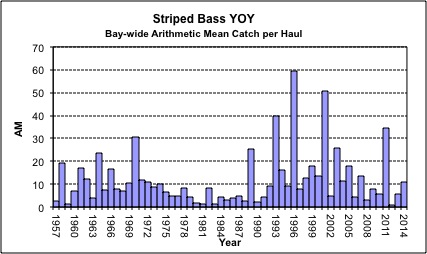
The 2014 number is 11.02. This is sure to be a great number for the spin doctors. Looking at it positively this may be the best of the last three years, but in reality this is another very mediocre number and certainly not one that will allow continuing harvesting striped bass at current levels. One of our SF board members once said that a classic sign of a species in trouble is when both the lows and the highs of spawning success are in decline. The average of the last 3 years is now about 5.9 which is only slightly better than the levels experienced during the crash of the late 70s and 80s and just half of the long term average of 11.8 taken from 1957 through 2014.
In the graph above you will note that the large years happened quite regularly throughout the 1990s; these big years were needed to produce the great fishing that encouraged angler participation, tackle sales, and sustained the guiding industry. In fact there were five years within the 15 year period of 1989 to 2003 that had a young of the year counts above 20. In the 11 years from 2004 through 2014, there has been only 1.
Of extra concern is that while that one year class – 2011- was very large those fish should be about 17 or 18 inches this fall and they should be everywhere, but no one seems to be finding that to be the case. In fact the entire summer of 2014 was very spotty for school bass fishing. Some locations along the coast reported quite a few while many normally good spots had almost none or only a few good days. However many there will be as three year olds there will surely be many fewer in the future as they are harvested first in the Chesapeake Bay and later the coastal fisheries. So in summary we feel that while the 2014 year class is not bad news, it provides no reason to abandon the major reductions in harvest the ASMFC will be contemplating on Wed. 10/29.
Click here to view the MD DNR young of the year page. Click on either geometric or arithmetic mean to download the excel document. (If the pages opens up and asks for a password, but just X that window out and the document will open up anyway.)
SF Full Comments to ASMFC Draft Addendum IV to Amendment 6
STRIPERS FOREVER COMMENTS TO DRAFT ADDENDUM IV TO AMENDMENT 6 TO THE ATLANTIC STRIPED BASS INTERSTATE MANAGEMENT PLAN FOR PUBLIC COMMENT
Stripers Forever is a not for profit organization that advocates for the conservation and responsible stewardship of striped bass.
Stripers Forever (SF) believes that the Atlantic States Marine Fisheries Commission (ASMFC) has given too much consideration to reducing potential social and economic impacts on the commercial striped bass fishery, and too little on managing the striped bass fishery as a public resource for the greatest user of this resource, the recreational angling community and the industry it supports. The signs of diminishing abundance have been ignored for years and have finally resulted in yet another attempt to follow the failed policies of the past instead of actually doing something proactive to improve fish abundance. The draft addendum for public comment at best proposes measures that fit the “too little, too late” model that has plunged this resource toward pre-moratorium abundances and now proposes measures that have a 50% probability of failure.
We believe that ASMFC should take as large a bite out of this apple as it can and we support the following options:
Proposed Fishing Mortality Reference Points (2.5.1) While the Technical Committee has been candid in their assessment of risks associated with the proposed new reference points, managing under the old reference points (Option A) has failed to stabilize SSB. We support the 2013 Benchmark Stock Assessment F Reference Points (Option B) for both coastwide and Chesapeake Bay fisheries because they represent the most
conservative approach to the problem.
Proposed Fishing Mortality Reference Points (2.5.2) We support Option B since the Technical Committee does not have the needed information to set up separate reference points for separate Chesapeake Bay management.
Albemarle Sound Reference Points (2.5.3) We have no comment on this question.
Timeline to Reduce F to the Target (2.6). Since the one year time frame represents the most aggressive approach to reaching the stated goals, we support Option A.
Proposed Management Scenarios (3.0). It seems redundant and confusing to select Option A under section 2.6 and then to have to select Option B in this section to support taking the largest possible reduction (25% of the 2013 harvest) in one year. We support Option B.
Proposed Recreational Fishery Management Options, Coastal Recreational Fishery.
Stripers Forever supports option B1 which is a one fish bag limit with a minimum size of 28-inches. We would prefer to see an option for a 28-34” slot but with a total bag limit of one fish, but it is not offered.
Proposed Recreational Fishery Management Options, Chesapeake Bay.
Since the objective is to increase the SSB, it doesn’t make sense to kill the largest, most productive spawners we already have while we wait for the 2011 year class to provide a greater number of smaller fish to make up for trophy fishing. Option B12 would effectively end the spring trophy season where the Bay jurisdictions get to kill large spawners that don’t count toward their coastwide quota. We support Option B12.
Proposed Commercial Fishery Management Options. The statement, “It is important to note none of the management options presented in the tables achieve a 25%
reduction from 2013 harvest” reveals an apparent inconsistency regarding the commitment to treat all stakeholders equitably. For the Coastal Commercial Fishery, it appears that Option B16 (taking a reduction of 25% from the Amendment 6 quota) is the only choice provided. It isn’t clear why this fishery isn’t held to the 2013 harvest baseline like the others.
The consideration of alternate options for the Chesapeake Bay Management Area Commercial Fishery seems unwarranted. The Bay jurisdictions claim they had a lower quota in 2013 so they would like to have their cut come from the 2012 harvest. Missing from this discussion was the fact that the Bay jurisdictions increased their quota (and probably harvest) for 2014 when the exploitable biomass increased due to the 2011 year class reaching 18” in length. We support Option B17 to take the 25% from the 2013 commercial quota. The Bay commercial fishermen have already been repaid for whatever happened in 2013.
SB is opposed to commercial quota transfers. If a state can’t catch their quota, it may be because they don’t have enough fish. It doesn’t make sense to transfer that quota to another state that does have fish and maintain the coastwide harvest to help ensure that more states won’t have enough fish next year. We support Option A – no commercial quota transfers.
All stakeholders should be fishing on the same size limits. We support Option A to constrain the commercial fishery in each jurisdiction by the same size limits established for that jurisdiction’s recreational fishery.
Compliance Schedule (4.0). The schedule has been compressed by the protracted debate over Chesapeake Bay reference points but the end point seems firm – no later than January 1, 2015, as it should be.
Sincerely;
Ken Hastings
Atlantic States Marine Fishery Commission Policy Coordinator for Stripers Forever
——————————————————————————
Send written comments to :
Mail: Mike Waine, Fishery Management Plan Coordinator
Atlantic States Marine Fisheries Commission (Subject: Draft Addendum IV)
1050 North Highland Street Suite 200A-N
Arlington, VA 22201
Phone: (703) 842-0740
Fax: (703) 842-0741
Email: mwaine@asmfc.org; (Subject: Draft Addendum IV)